Room guide
A good piece can still be wrong for its position.
We tend to assess furniture one object at a time, while the room experiences everything at once. Proportion is less about matching dimensions than establishing order.
Read the architecture before the furniture.
Begin with what cannot easily move: doors, windows, arches, fireplaces, changes in floor level, and the direction of daylight. These features establish the room's natural pauses and passages.
A strong opening benefits from a clear approach. An arch can frame a cabinet or chair in the adjoining room, but the effect weakens when several smaller objects compete at its edge.
Choose an anchor with enough authority.
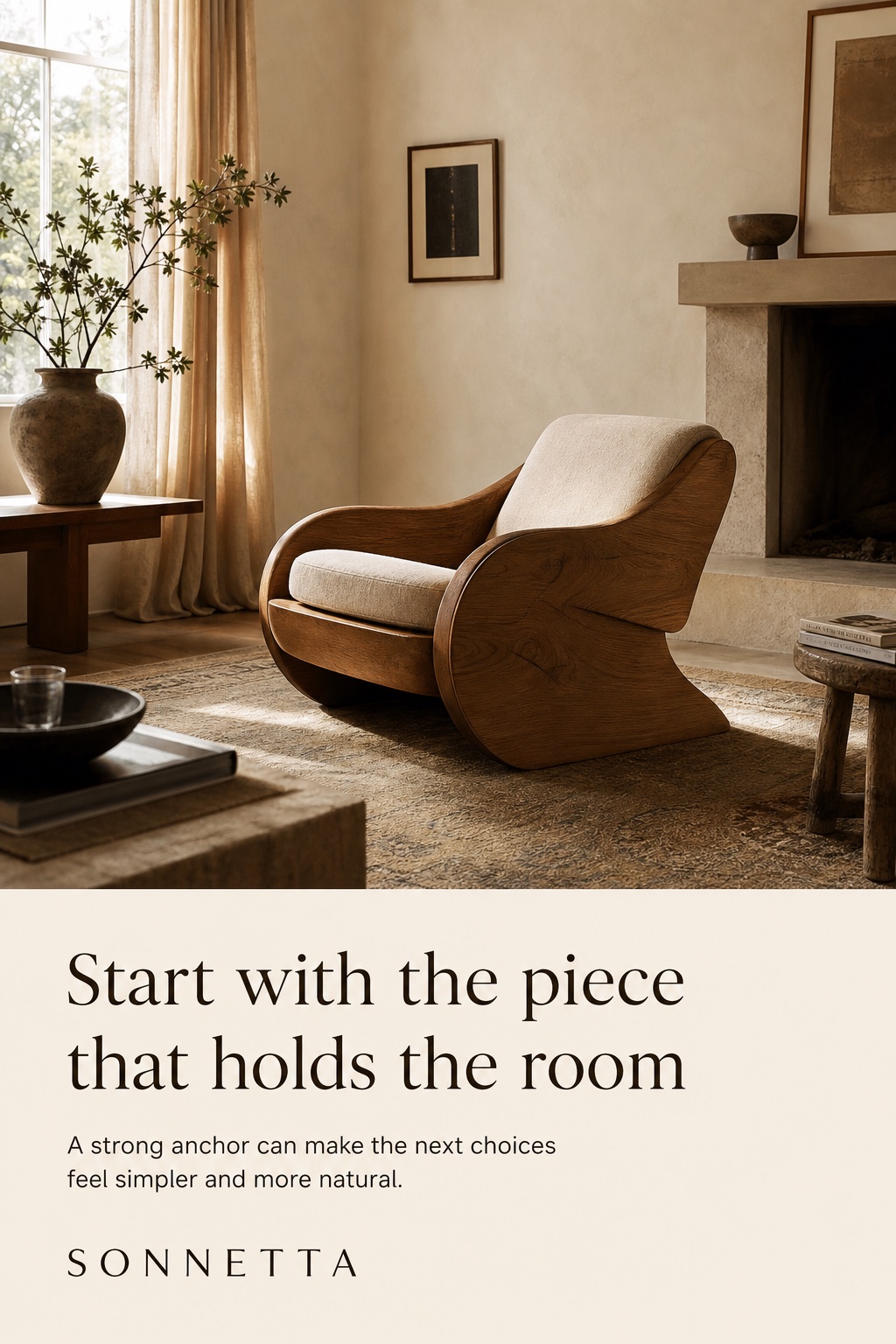
Rooms often feel unsettled not because they contain too much, but because nothing is allowed to lead. The anchor might be a dining table, a cabinet with material presence, a generous rug, or a chair positioned in relation to the light.
Once it is established, smaller decisions become easier. Side tables serve seats, lighting supports activity, and open space becomes purposeful rather than accidental.
Test the silhouette, not only the footprint.
Measurements tell us whether furniture will fit. They do not tell us how much visual space it will occupy. Notice the back height, openness beneath the seat, depth of the top, and whether the legs appear light or grounded.
Mark the footprint, then stand at the threshold. The view from the doorway often reveals imbalance sooner than the close view.
Preserve one generous interval.
A room can feel composed when one interval is notably generous: space around a dining table, breathing room beside a cabinet, or an open route toward a window.
This gives the eye somewhere to rest and lets ordinary life happen without negotiation when pulling out a chair, carrying a tray, or opening a drawer.
Let adjacent rooms speak to one another.
In connected rooms, scale is read across thresholds. Repetition of material can connect the spaces, but exact matching is rarely necessary. A shared note of timber, stone, plaster, or woven fiber may be enough.
Measure by use.
Can someone sit without blocking the passage? Can drawers open fully? Does the table accept both a meal and the spaces between meals? The room finds its measure when movement feels unforced and nothing must explain why it is there.