Before they arrive
A nursery does not need to announce its category
A library does not need a wall of signs that say reading. A kitchen does not need art about cooking. Yet nurseries are often asked to prove what they are through clouds, moons, animals, alphabets, and objects that may feel obsolete almost as soon as the child can name them.
There is another way to begin. Notice the house’s colors, thresholds, wood tones, and light. Give the adult who will spend long hours in the room a genuinely comfortable place to sit. Make storage useful now without preventing it from becoming a library, dresser, or desk later. Let the crib be safe and quiet rather than decorative.
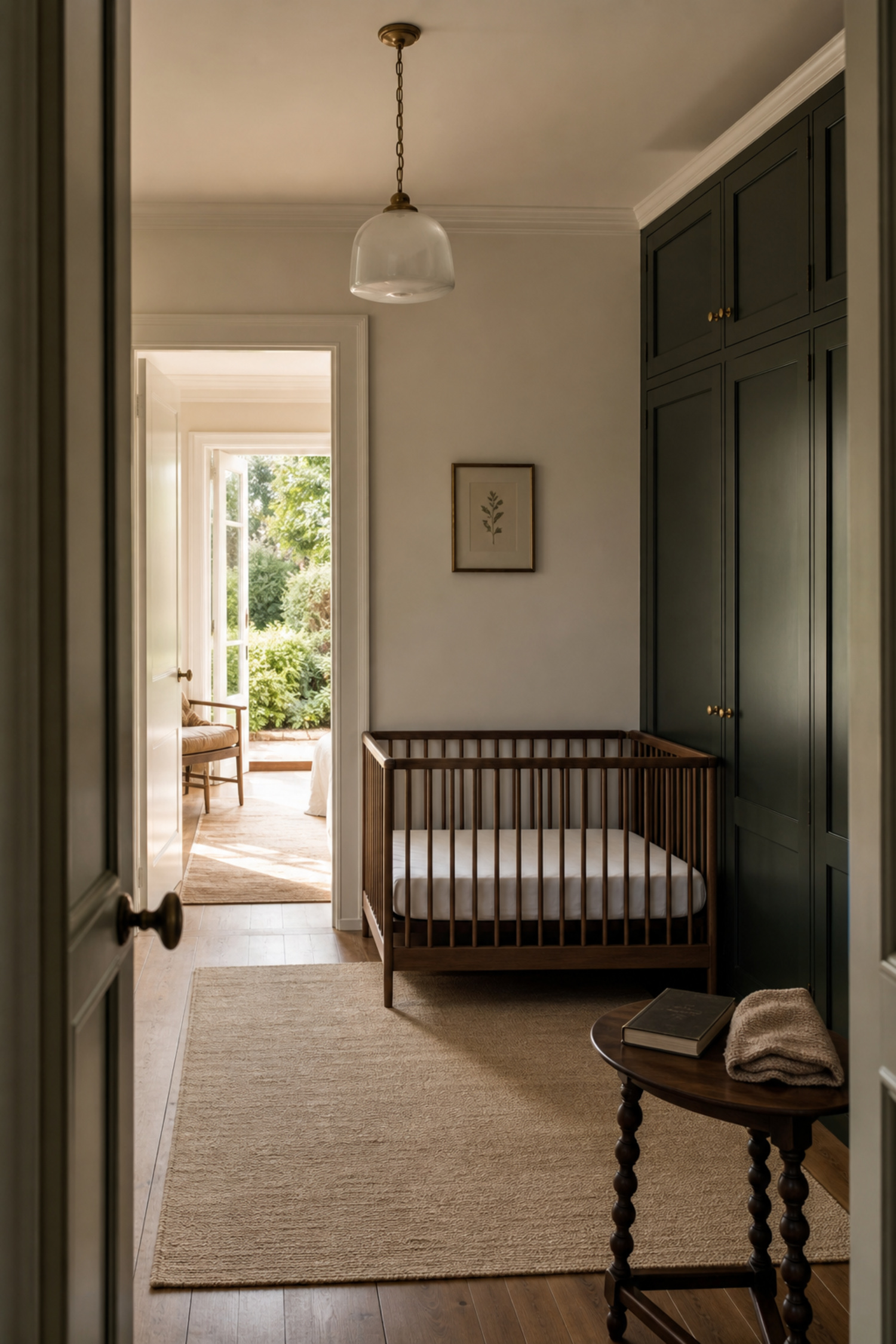
1. Begin with the house, not a theme
Stand at the nursery door and look in from the hall. Blackened-green trim, shell-pink plaster, aged oak, a patterned runner, or morning light moving through several rooms can establish continuity before any furniture arrives.
A nursery can still have its own identity. The useful distinction is between a room-specific decision and a purchased theme. Repeating one subject across every object creates a theme. Continuing the house’s colors and materials while planning for sleep, storage, and an adult chair gives the nursery its own character without separating it from the rooms around it.
2. Choose one brave adult color
Calm does not require absence. One confident color can give the room enough identity that it needs fewer decorative objects. Mineral blue can turn a narrow room into a deep visual field. An oxblood ceiling can make a small room feel deliberate. Blackened-green cabinetry can connect the nursery to the library or hall outside it.
Use color on something architectural: a wall, ceiling, door, built-in, or deep reveal. Ask whether it will remain beautiful when the crib is gone.
3. Give the adult a real place in the room
The chair supports feeding, reading, waiting, and the quiet minutes when nobody is asleep yet. Choose it with the standards used for any frequently occupied chair: an appropriate seat height, support, room to stand, a useful light, and a surface for water or a closed book.
An adult chair that could later move to a bedroom or library gives the nursery a future before anything needs replacing.
4. Let the crib be the quietest object
This is where styling stops and current infant-safe-sleep guidance begins. The American Academy of Pediatrics advises a firm, flat, non-inclined sleep surface. Its guidance keeps blankets, pillows, bumper pads, stuffed toys, and other soft objects out of the infant sleep space.
A bare, well-proportioned crib against a quiet wall can anchor the room without becoming a display surface. The U.S. Consumer Product Safety Commission recommends cordless window coverings where young children are present and advises moving cribs, beds, furniture, and toys away from windows and window-covering cords, preferably to another wall.
Review the current AAP safe-sleep guidance and CPSC window-covering guidance for the actual room and child.
5. Make the nighttime route obvious
Walk from the door to the chair and crib. Keep the route free of low tables, baskets, lifting lids, trailing textiles, and curled rug corners. Layer a controlled low light for entering with task light where the adult sits, keeping cords and fixtures outside a child’s changing reach.
6. Make storage architectural and adaptable
Use closed storage for volume and visual noise. A handsome low dresser can remain after a removable changing function is no longer needed. Built-in cabinetry can move from clothing to books, games, or school materials. A window seat can become reading, conversation, and ordinary household storage.
Stability is not visible proof of safety. The CPSC advises using anchors to help prevent furniture and appliance tip-overs. Follow the manufacturer’s instructions and use appropriate anchoring for the furniture, wall, and installation.
7. Plan the room after the crib
Remove the crib mentally. If a good chair, low library, useful storage, clear patch of floor, and one strong color decision remain, the room already has another life. Leave some space unassigned. The room will teach you what it needs through use.
The before-they-arrive audit
- What connects this room to the rest of the house?
- What is the one memorable color or architectural decision?
- Does the adult have a genuinely supportive place to sit?
- Is the crib bare and positioned according to current guidance and product instructions?
- Is the nighttime route clear?
- Can the storage perform another job later?
- What room remains when the crib leaves?
This article offers general editorial guidance, not medical advice, product-safety certification, or installation approval. The hero is conceptual imagery. Verify current AAP and CPSC guidance, manufacturer instructions, recalls, standards, anchoring, and the actual room before use.
Continue with children’s furniture that converts, beautiful playroom storage, or explore Children’s Rooms Worth Keeping.