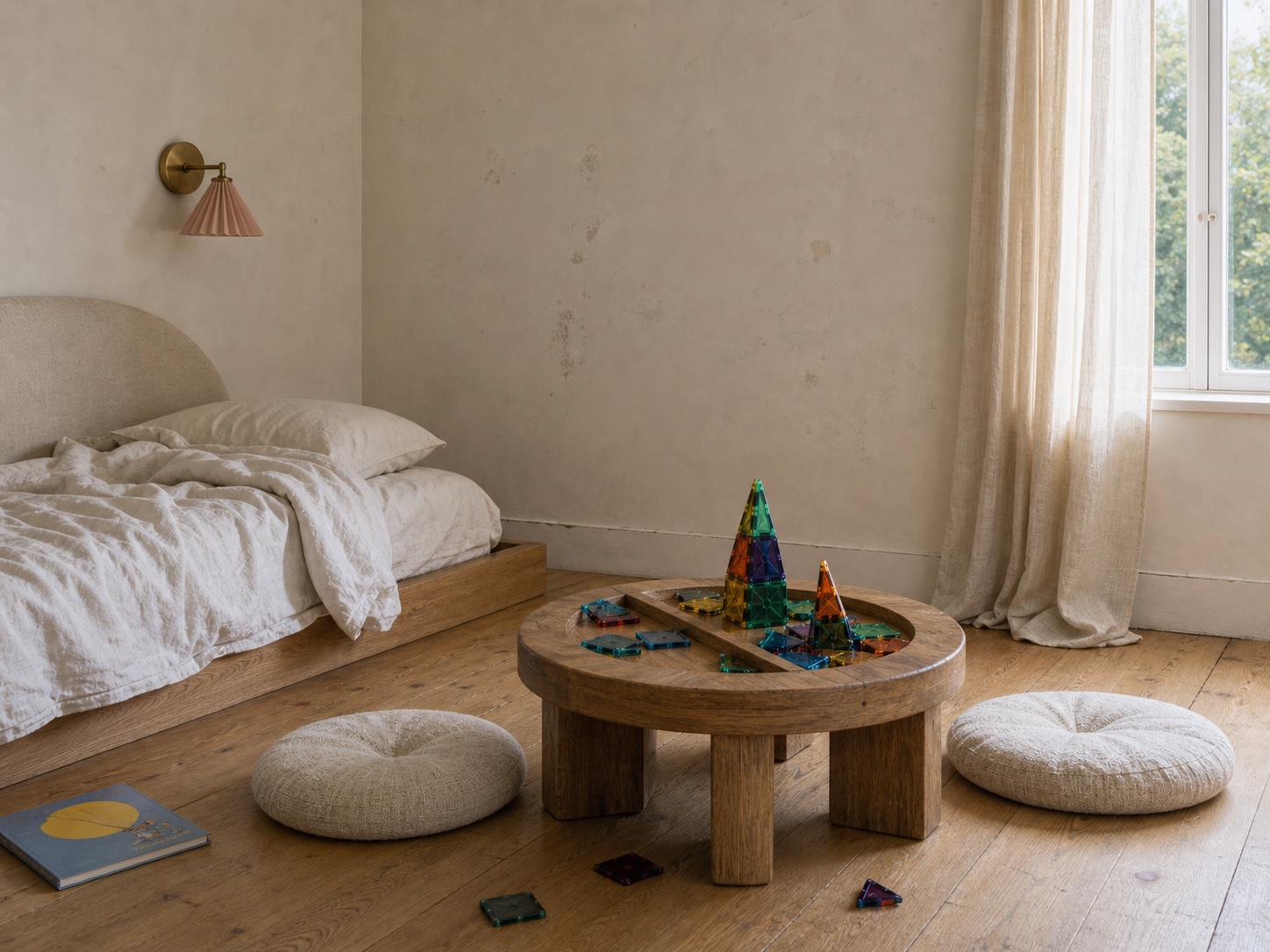
Whimsy with structure
Children’s furniture can be beautiful enough for the whole house
Children do not need their furniture to look like smaller beige versions of ours. A chair can have ears. A bed can suggest a tree or a caravan. A stool can be a sheep. The question is whether the idea has been resolved as furniture or merely applied to it.
Good whimsy usually comes from proportion, silhouette, movement, color, or a new way to use the piece. It leaves enough room for a child to invent the story. It also survives the ordinary tests of a room: opening, climbing into bed, sitting down, putting things away, cleaning, repairing, and eventually passing the piece on.
Six smaller makers worth knowing
This is not a ranking and it is not a blanket endorsement of every product. Materials, tests, age guidance, delivery, and availability differ within a collection. The purpose of the edit is to identify makers doing something specific while keeping the remaining questions visible.
EO Play
Based: Copenhagen, with European production
Best for: Animal forms that still behave like serious furniture
Marc Venot’s Elephant Chair is a useful test of good whimsy: the ears and trunk create the character, but the object remains a composed beech chair. EO publishes a matte-lacquered European-beech construction, EU manufacture, a 60-kilogram maximum load, and an intended age range of three to eleven.
Before buying: The public product page gives useful age, material, origin, and load information, but we would still request the current product-level test documentation before making a broader safety claim.
Mathy by Bols
Based: Mariembourg, Belgium
Best for: Rooms that become a cabin, caravan, tent, or tree without becoming stage scenery
Mathy by Bols has made children’s furniture in Belgium for forty years. Its range is unusually imaginative, but the better designs remain legible as beds and storage. The company publishes PEFC-certified wood, more than thirty water-based lacquer colors, customization, and workshop production in Belgium.
Before buying: Construction varies by collection and may combine solid wood with MDF. Check the exact material schedule, applicable standard, assembly requirements, and delivery route for the piece, not the brand story alone.
Gustavienne
Based: European design and manufacture
Best for: A quiet room with one perfectly judged animal object
Gustavienne’s principal furniture is restrained and Gustavian, which makes its Emil rocking sheep and Bertil and Gustav stools feel more charming, not less. The company publishes solid Northern European birch, European manufacture, and water-based, solvent-free, low-emission finishes.
Before buying: The company cites EN 716 and related nursery standards for applicable furniture. That should not be extended to every stool, rocker, or decorative object without the product-specific documentation.
GRIMM’S
Based: Germany and Europe
Best for: Color and open-ended forms that sit between furniture and play
GRIMM’S is better known for wooden play materials, but its stools, shelving, and play furniture carry the same precise color language. The family-run company develops, oils, paints, assembles, quality-checks, and packs its products in Germany; small independent workshops in Germany and Europe handle the wood processing.
Before buying: Treat each furniture piece separately. Confirm its intended age, load, installation, and current product-level testing rather than transferring evidence from the toy range.
ecoBirdy
Based: Antwerp, with production in Italy
Best for: A visible circular-material story that children can understand
The Charlie Chair is made from recycled plastic whose earlier life remains visible in its speckled surface. It is playful without imitating an animal or character. ecoBirdy publishes Italian manufacture, an intended age range of eighteen months to seven years, indoor and outdoor use, A+ VOC-emission results, and named European children’s-furniture testing.
Before buying: The chair is a strong editorial object; still verify current US shipping, stock, and the exact certificate attached to the color and production batch being purchased.
Wood Luck Design
Based: Bieszczady, Poland
Best for: Scallops, rounded cabinets, and folk-inflected color without a disposable nursery look
The Babushka, Bloom, Mountains, and Vintage collections give Wood Luck a recognisable language. The Bloom creative-table kit is particularly intelligent: it turns frames left after converting the 70 × 140-centimeter Bloom cot bed into a couch into the base for a full-sized table. The company describes local Polish production, water-based finishes, and a deliberate mix of solid wood, plywood, MDF, and furniture board rather than disguising every surface as solid wood.
Before buying: This is a conversion kit, not a standalone table: it depends on owning the compatible Bloom cot bed and requires self-assembly. Wood Luck identifies EN 71-3-compliant MDF and water-based varnish for the kit, but US fulfillment and any product-level structural or load testing should be confirmed before a commerce recommendation.
Three more studios belong on the discovery list
Treehole. This Polish birch-plywood structure extends from a bed into a sculptural place to hide, read, rest, and play. The concept is excellent; the current public technical and fulfillment information is too thin for a buy-now recommendation.
Wood Republic. Its NEST.play structure is made in the company’s carpentry shop from certified materials, with birch plywood and child-certified natural oil-wax finishes. We would want the exact bed standard, load testing, installation requirements, and US delivery terms for the chosen configuration.
Craft Maestro. A husband-and-wife workshop in Wrocław makes cloud shelves, animal forms, and hand-finished room pieces with genuine charm. The maker story is promising, but public material, finish, testing, warranty, and international-delivery evidence needs to become more specific before commerce coverage.
Whimsy should not be used to hide the specification
A charming photograph cannot tell us whether a tall cabinet includes an anti-tip system, whether a painted surface has a documented finish, or whether a bed has been tested to the standard claimed for it. ‘Made in Europe’ is useful provenance, not a complete safety certificate. FSC and PEFC describe sourcing, not whether an entire piece is solid wood or whether it will be easy to repair.
We look for the named designer or workshop, exact materials, place of manufacture, finish, intended age, relevant standard, load or installation instructions, replacement parts, warranty, and a route to ask a real question. When those details are missing, the piece can remain a discovery without becoming a recommendation.
The best object leaves part of the story unfinished
The Elephant Chair does not dictate what happens next. Neither does a colored GRIMM’S stool or a bed that loosely suggests a cabin. They offer a beginning, then let the child take over. That may be the difference between furniture with imagination and furniture performing childhood for the adults who bought it.
Continue with furniture that converts instead of being replaced, beautiful playroom storage, children’s storage chests that can become keepsakes, or explore Children’s Rooms Worth Keeping.