One decision at a time
The empty space is doing half the work
A branch arrangement is not only the branches. It is also the shape of the air around them. When every stem stands at the same angle or occupies the same amount of space, the eye sees repetition before it sees the natural line of the material.
The strongest arrangement here is not symmetrical, but it is balanced. One high branch establishes the gesture. A lower branch reaches in the opposite direction. The smaller lines connect the two without filling every opening.
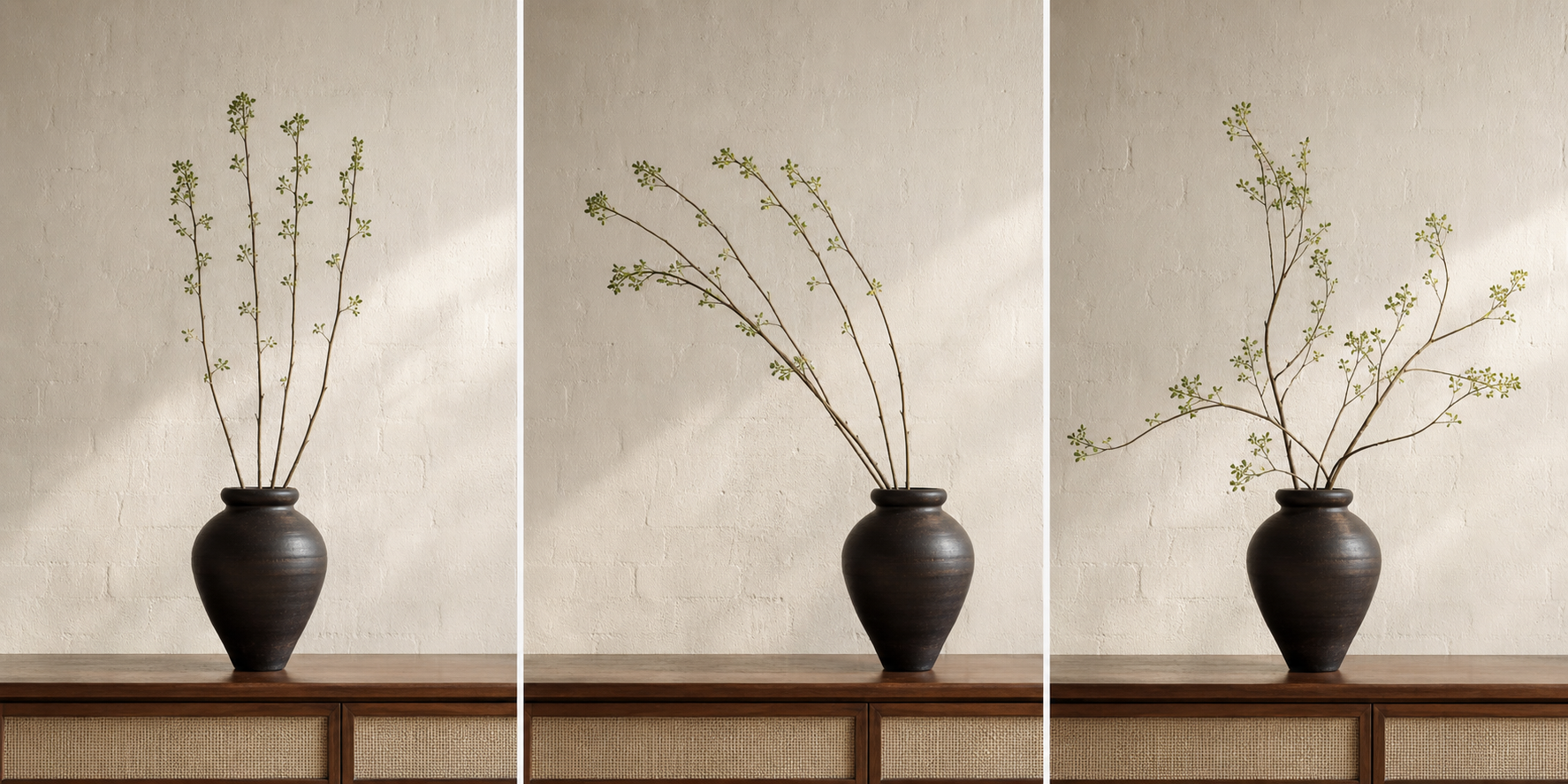
Straight up can feel more placed than grown
The first arrangement is orderly and easy to understand. That is also why it feels rigid. Similar heights, upright stems, and even gaps produce a fence-like rhythm. Nothing is technically wrong, but the natural gesture of each branch has been subordinated to neatness.
If an upright arrangement feels stiff, do not immediately add more. Rotate the most expressive branch away from the center and let one fork occupy the open wall around it.
Movement still needs a counterweight
In the second arrangement, every branch travels in the same direction. The repetition creates energy, but the eye follows that energy straight out of the composition. The vase begins to look as though it is preventing the branches from falling rather than holding them naturally.
One shorter branch turned back toward the open side can be enough. It does not need to match the dominant gesture. It only needs to answer it.
Controlled asymmetry feels alive because it is legible
The third arrangement has a clear high point, a lower reach, irregular intervals, and several distinct openings. Its silhouette changes as the eye moves across it. The branches overlap near the vase, then separate before their tips, so each line remains visible.
This is controlled asymmetry: the two sides are different, but their visual weight feels resolved. It resembles growth without pretending to be accidental.
A five-minute way to restyle branches
- Start with the branch that has the clearest natural gesture. Let it determine the first direction instead of forcing it upright.
- Add a shorter branch in the opposite direction to keep the arrangement from visually tipping.
- Vary height, angle, and distance. Avoid an even fan or a tidy staircase.
- Turn branches until their forks occupy open areas rather than hiding behind one another.
- Remove one stem before adding another. A branch arrangement often improves before it looks full.
- Step back and judge the outer silhouette. The view from the vase opening is rarely enough.
The vase sets the limit
A narrow mouth gathers branches into a stronger base and makes a sparse arrangement easier to control. A wide mouth allows more separation, but it may need a heavier vessel or a branch with more horizontal reach to keep the composition grounded.
The branches can be generous, but the vessel should still read as their anchor. If the arrangement looks top-heavy, shorten one stem, widen the lowest gesture, or choose a vase with more visual weight.
When symmetry is the right choice
Symmetry can be useful when the room already contains strong movement, when two objects are intended to mark an opening, or when the branches themselves have an unusually architectural form. The goal is not asymmetry for its own sake. It is to make the arrangement respond to the material and the room.
Continue with how to judge an object before it is styled or why the right room often needs less.